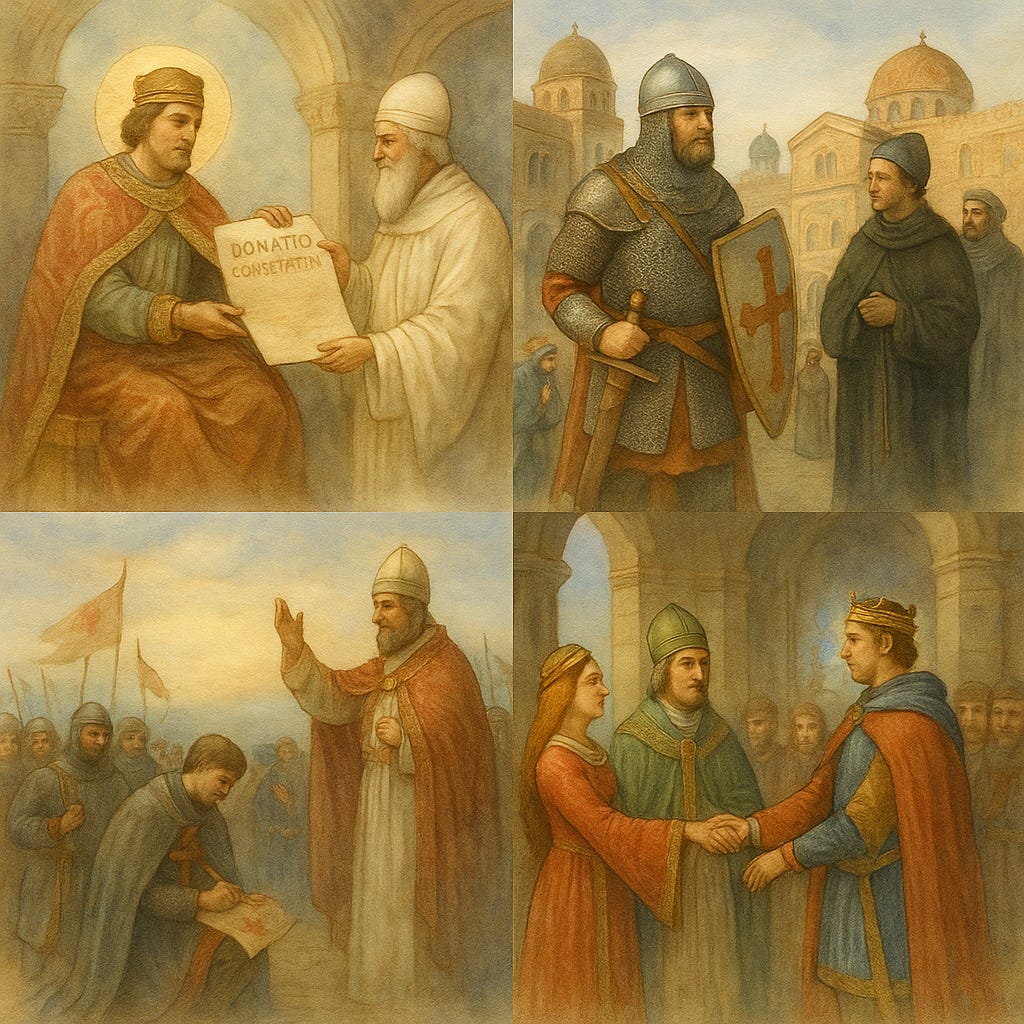

Dante opens this chapter with a curse: “Ah, Constantine, how much evil was born from that false donation.” The forgery he meant—the Donation of Constantine—claimed that the first Christian emperor had granted the pope temporal power over the Western Empire. In the eighth century, that fiction became fact when Pope Stephen II invoked it to crown Pepin the Short, creating the Papal States. From that moment, popes were no longer merely shepherds of souls—they were political sovereigns.
For a time, that alliance with the Franks bound the Church to rising northern power. The Carolingians defended Rome, and Rome sanctified their rule. But by the tenth century, papal politics had curdled into patronage and scandal—pontiffs made and unmade by local nobles and imperial meddling. Reform came slowly, carried first by monastic movements like Cluny, which preached clerical discipline and moral renewal. When Pope Gregory VII took office in 1073, those ideals became policy. His Gregorian Reforms demanded clerical celibacy, denounced simony, and—most provocatively—asserted that only the pope could appoint bishops. That declaration sparked the Investiture Controversy, pitting the papacy against emperors and kings from Germany to England, and redefining obedience within Christendom.
Meanwhile, a new Norman energy was reshaping Europe from two directions. In the south, a different branch of Normans—adventurers from the same northern stock but unconnected to William’s line—conquered southern Italy and Sicily under leaders like Robert Guiscard and Roger Hauteville. Their kingdom fused Latin, Greek, and Arab traditions, becoming both a bridge and a buffer between Christendom and the Muslim world. The papacy, surrounded by rivals in Italy, found in these Normans a crucial ally—and sometimes a reminder that its own warriors could be as ambitious as its emperors.
Out of this shifting political and spiritual order came the first great call to arms. In 1095, Pope Urban II summoned Europe’s knights to reclaim Jerusalem. The First Crusade bound Christendom to a single purpose, channeling feudal violence into holy war and briefly uniting rival kingdoms under the sign of the cross. When Jerusalem fell in 1099, the papacy’s prestige soared, and a new network of faith, commerce, and diplomacy began to knit the Mediterranean together. Italian ports thrived on crusader traffic; the Norman lords of Sicily supplied men and ships; and the idea of Christian Europe gained both definition and ambition.
In that newly connected world, dynasties turned faith and geography into power. Half a century later, Eleanor of Aquitaine—heiress to one of Europe’s richest duchies and a veteran of crusade herself—married Henry Plantagenet, soon to be Henry II of England. Their union linked the culture of southern France to the political might of the north, forming the Angevin Empire and tying the Channel kingdoms to the same Mediterranean sphere that the Crusades had opened.
My takeaway: The genius of the medieval Church was structure not holiness. In reforming itself, it built the first truly European institution, one that could outlast kings, command armies, and shape imagination. The papacy reinvented Rome’s empire and put the economic, political, and martial power of kings behind its initiatives.